We are familiar with elementary conditional identities in a triangle. We know that A + B + C = 180º in a triangle. General conditional identities can be derived by taking sine, cosine or tangent of both side or taking sine, cosines or tangents after transposing one angle to the other side. We may also divide by 2 and follow the same steps.
(i) In any triangle tan A tanB + tanB tanC + tanC tanA must be equal to –
Text Solution
Verified by ExpertsCHECK THE SOLUTION.
(i)
In any triangle cos (A + B + C) = –1
⇒ cos A cos (B + C) – sin A sin (B + C) = –1
⇒ cos A cos B cos C – cos A sin B sin C – sin A sin B
cos C – sin A cos B sin C = –1
Now divide by cos A cos B cos C to get the choice .
(ii)
Divide the identity of above question by tan A tan B tan C.
(iii)
Convert to sine and cosine
(iv)
Applying sine rule in Δ OAB, we get
 =
= 
or OB =  ... (i)
Again applying sine rule in Δ OBC, we get
 =
= 
or OB =  ... (ii)
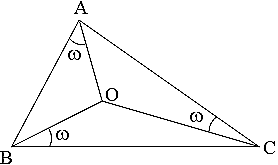
Equating the value of OB in (i) and (ii), we get
 =
= 
⇒  =
=  (sin C cos ω – cos C sin ω )
⇒  = sin A (cot ω – cot C)
⇒ cot ω – cot C =  =
= 
⇒ cot ω – cot C = cot A + cot B
⇒ cot ω = cot A + cot B + cot C
Now, (ii) follows by squaring (i) and using the fact cot A cot B + cot B cot C + cot C cot A = 1.
Prepare Smarter with CGP Edu
Get practice questions, solutions, and test series in one place.
Write a Review
Share your experience with this question and solution.
Commentary
Send your comment, doubt, correction, or feedback to admin.
Similar Questions
Explore conceptually related problems